
How Retaining Walls Help With Drainage and Erosion Control

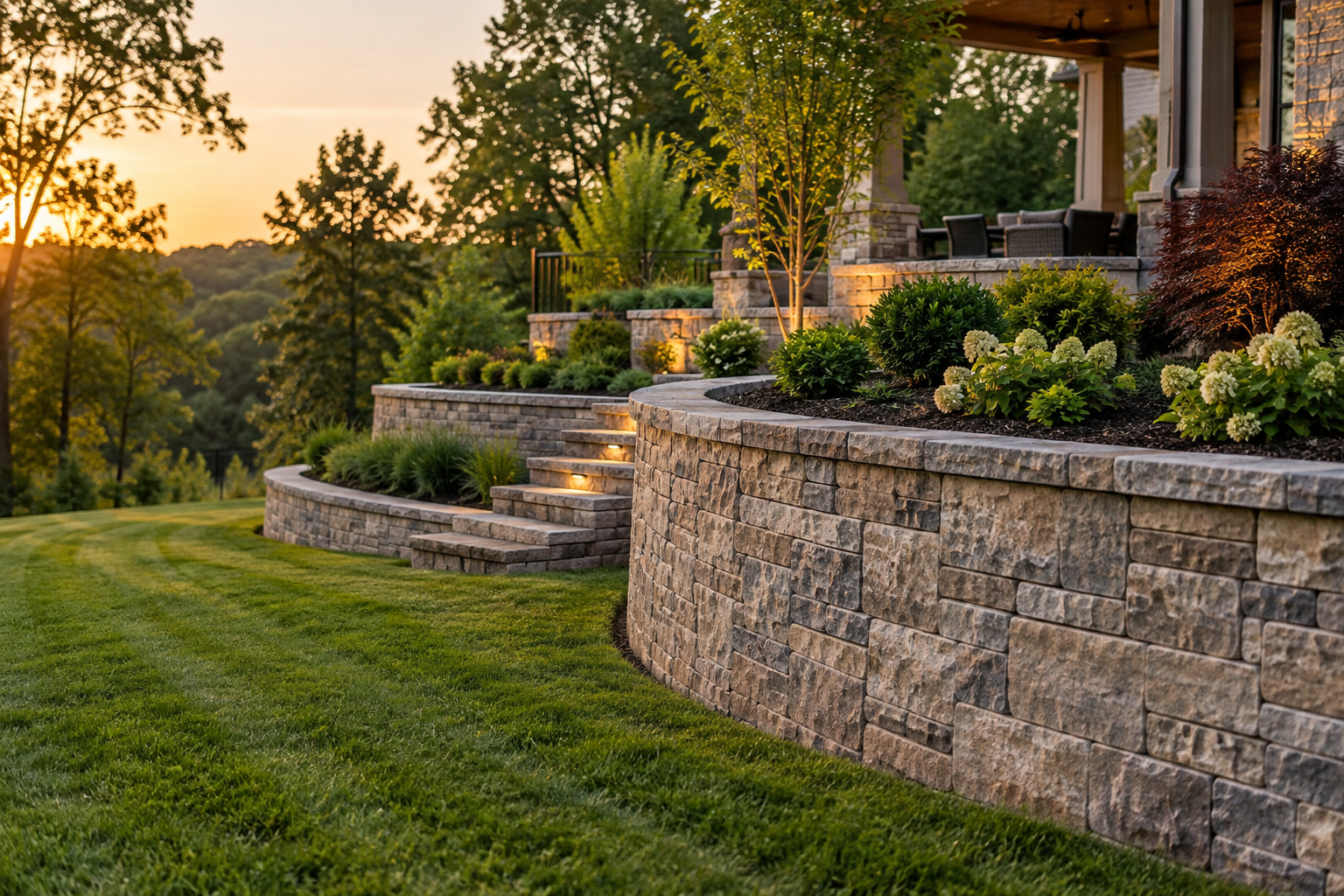
A sloped yard can add natural beauty and character to a property, but it can also create serious challenges when heavy rain begins moving water and soil downhill. Over time, uncontrolled runoff can wash away landscaping, create muddy areas, expose plant roots, damage patios, and potentially direct unwanted water toward your home.
One of the most effective ways to manage these problems is a professionally designed retaining wall. However, a retaining wall does much more than simply hold soil in place. When properly planned, it can become part of a complete system for controlling slopes, directing water, reducing erosion, and creating more usable outdoor space.
Understanding how retaining walls help with drainage and erosion control is especially important for homeowners in Middle Tennessee, where rolling terrain and periods of substantial rainfall can make water management an important part of landscape design.
Why Do Sloped Yards Experience Erosion?
Erosion happens when soil is displaced by water, wind, or other forces. In residential landscapes, stormwater runoff is often one of the biggest contributors.
When rain falls on a steep yard, gravity causes water to move downhill. The faster that water travels, the more soil it may carry with it.
You may begin noticing warning signs such as:
- Soil collecting at the bottom of a slope
- Exposed tree or plant roots
- Washed-out mulch
- Channels forming through landscaping
- Mud collecting on patios or walkways
- Bare areas where grass struggles to grow
- Water pooling in low areas
- Soil moving away from foundations or landscape beds
Ignoring erosion can allow the problem to become progressively worse. Addressing the slope and water movement early may help protect both landscaping and hardscape investments.
How Retaining Walls Reduce Erosion
A retaining wall is designed to hold soil at different elevations. Instead of allowing a steep slope to continue uninterrupted, the wall creates a stable transition between higher and lower areas.
This can reduce erosion in several ways.
Retaining Walls Shorten Steep Slopes
A long, steep slope gives runoff more distance to gain speed.
Adding a retaining wall can break that slope into shorter sections or create terraces. By reducing the length and steepness of exposed slopes, water movement can become easier to manage.
Retaining Walls Hold Soil in Place
The wall provides structural support to the soil behind it. This helps prevent soil from gradually moving downhill due to gravity, rainfall, and erosion.
Terracing Can Create Stable Landscape Areas
On larger slopes, multiple retaining walls may be used to create terraces.
These terraces can provide flat or gently sloped areas for:
- Plants
- Lawn
- Garden beds
- Walkways
- Seating areas
- Patios
Instead of one difficult hillside, the property gains several manageable levels.
Retaining Walls and Drainage Work Together
A common misunderstanding is that the retaining wall itself stops water.
It doesn’t.
Water still needs somewhere to go. In fact, controlling water behind the wall is one of the most important parts of proper retaining wall construction.
Soil becomes heavier when saturated with water. If water builds up behind a wall without adequate drainage, hydrostatic pressure can place significant stress on the structure.
That’s why retaining wall drainage must be considered during the design process rather than added as an afterthought.
What Goes Behind a Properly Built Retaining Wall?
The exact construction method depends on the wall type, height, soil, site conditions, and engineering requirements. However, retaining wall systems often include several important drainage components.
Drainage Aggregate
Free-draining stone or gravel may be placed behind the wall.
Unlike compact soil, aggregate allows water to move more freely instead of remaining trapped directly against the structure.
Drain Pipe
Some retaining wall systems incorporate perforated drainage pipe near the base.
The pipe collects water and directs it toward an appropriate discharge location.
Filter Fabric
Geotextile or filter fabric may be used to help separate soil from drainage material.
This can help prevent fine soil particles from migrating into the aggregate and reducing its drainage effectiveness.
Proper Backfill
The material placed behind a retaining wall is important. Appropriate backfill and proper installation can help the wall manage both soil pressure and water.
These components work together as a system. Simply stacking attractive blocks or stones without considering what happens behind them can create problems later.
Why Drainage Is Critical to Retaining Wall Longevity
Poor drainage is one of the major threats to retaining wall performance.
When water accumulates behind the wall, pressure increases. Over time, excessive pressure can contribute to problems such as:
- Bulging
- Leaning
- Cracking
- Separation
- Movement
- Premature wall failure
Water can also affect the soil supporting the wall.
For that reason, a retaining wall project should consider both structural support and water management from the beginning.
A beautiful wall is valuable, but a beautiful wall with a properly designed foundation and drainage system is what homeowners should ultimately want.
Retaining Walls Can Redirect Runoff
Depending on the property’s layout, retaining walls can also be incorporated into a larger drainage strategy.
The surrounding grade can be designed to guide surface water toward appropriate collection or drainage areas instead of allowing it to flow unpredictably across the yard.
A complete solution might combine retaining walls with features such as:
- Swales
- Catch basins
- Channel drains
- French drains
- Downspout extensions
- Proper grading
- Permeable landscape areas
The right combination depends on where the water originates and where it can safely be directed.
Creating Terraces for Steep Middle Tennessee Yards
Middle Tennessee is known for properties with hills and elevation changes. While that terrain can be beautiful, steep backyards sometimes leave homeowners with areas that are difficult to use.
Terraced retaining walls can address both problems at once.
Instead of maintaining one steep slope, several levels can be created. These new spaces may become planting beds, lawn areas, patios, or outdoor gathering spaces.
For example, a sloped backyard might be redesigned with an upper patio near the house, a retaining wall separating the elevations, and a lower fire pit or pool area.
In this situation, the retaining walls are not merely solving an erosion problem. They become an essential part of the overall outdoor living design.
Retaining Walls Can Protect Other Hardscape Features
Uncontrolled water and soil movement don’t only affect landscaping.
They can also threaten other outdoor improvements.
Properly planned retaining walls and drainage can help manage conditions around:
- Paver patios
- Pool decks
- Outdoor kitchens
- Fire pits
- Walkways
- Driveways
- Steps
- Gunite pools
If you’re investing in a complete backyard transformation, drainage should be addressed before expensive finishing features are installed.
Otherwise, water problems can undermine the long-term performance of the surrounding hardscape.
Choosing the Right Retaining Wall Material
Drainage performance is largely determined by design and installation, but the visible material also plays an important role in the finished appearance.
Popular options include:
Natural Stone
Natural stone works beautifully with traditional homes, wooded properties, and landscapes where a more organic appearance is desired.
Segmental Retaining Wall Blocks
Engineered block systems can provide structural performance along with consistent shapes and a wide range of colors and textures.
Large-Format Wall Systems
Larger wall units can create a substantial appearance and may work particularly well for modern landscapes or significant elevation changes.
The best material should complement the home, surrounding patio, pool area, and other hardscape features.
Retaining Walls Can Add Usable Yard Space
Drainage and erosion control may be the reason you initially consider a retaining wall, but increased usable space can become one of its greatest benefits.
By converting slopes into level areas, retaining walls can make room for features such as:
- Outdoor dining areas
- Fire pits
- Outdoor kitchens
- Pool patios
- Play areas
- Gardens
- Lounge spaces
This can be especially valuable on properties where the natural grade previously made much of the backyard difficult to use.
Why Professional Retaining Wall Design Matters
Not every retaining wall requires the same construction method.
Wall height, slope, soil type, drainage patterns, nearby structures, additional loads, and local requirements can all affect how the project should be designed.
A professional contractor can evaluate the entire property instead of focusing only on the location of the wall.
Important questions include:
Where is the water coming from? Where should it go? What is the wall supporting? How will the property drain after construction? Are there patios, pools, structures, or other loads nearby?
Answering these questions before construction helps create a more durable and effective solution.
Combine Function With Great Outdoor Design
Retaining walls don’t have to look purely structural.
With thoughtful planning, they can become attractive architectural elements within the landscape.
Walls can incorporate or complement:
- Built-in seating
- Steps
- Landscape lighting
- Planting beds
- Fire features
- Patios
- Pool areas
- Walkways
For example, a retaining wall surrounding a fire pit can manage an elevation change while also defining the gathering area. A wall beside a pool can support the landscape while creating a dramatic raised planting bed.
Good hardscape design allows practical solutions to become part of the property’s visual appeal.
Improve Your Property With Harpeth Valley Hardscape
At Harpeth Valley Hardscape, we design and build outdoor living spaces for homeowners throughout Middle Tennessee. Retaining walls are often an important part of these projects, especially on properties where slopes, drainage, and erosion affect how the backyard can be used.
Our team considers how retaining walls interact with the entire outdoor environment, including patios, gunite pools, outdoor kitchens, fire features, landscaping, and changes in elevation.
Rather than treating drainage as an afterthought, it should be considered as part of the overall design from the beginning.
Final Thoughts
Understanding how retaining walls help with drainage and erosion control can help homeowners make better decisions about sloped or water-prone properties.
A properly designed retaining wall can stabilize soil, break steep slopes into manageable sections, support drainage systems, protect other hardscape features, and create valuable new outdoor living areas.
However, successful retaining walls depend on much more than what you can see from the finished yard. Proper foundations, backfill, grading, drainage, and construction are critical to long-term performance.
If you’re dealing with erosion, drainage problems, or an unusable slope in your Middle Tennessee yard, fill out the form below to contact Harpeth Valley Hardscape. Our team can help you explore retaining wall and hardscape solutions designed for your property.


